

Building in Hobart
Australia's second-oldest capital city — a place of remarkable topography, strong arts culture, and a custom home market unlike anywhere else in Tasmania.
Tasmania's Capital, Built on Remarkable Terrain
Hobart is unlike any other Australian capital. Established in 1804 as the colony's second settlement, it sits at the foot of kunanyi/Mount Wellington on the western bank of the Derwent River — a landscape of extraordinary drama that defines the character of every suburb. The greater urban area is home to approximately 247,000 people, yet it retains the feel of a place that hasn't yet lost sight of the landscape around it.
The city's property market went through a decade of transformative change. From 2012 to 2022, Hobart was regularly cited as Australia's strongest-performing capital city market — driven by interstate migration, MONA's effect on cultural tourism, and a genuine reassessment of Tasmania's liveability. That cycle has moderated, creating a market with more realistic entry points and stronger fundamentals for those thinking about long-term investment in quality housing.
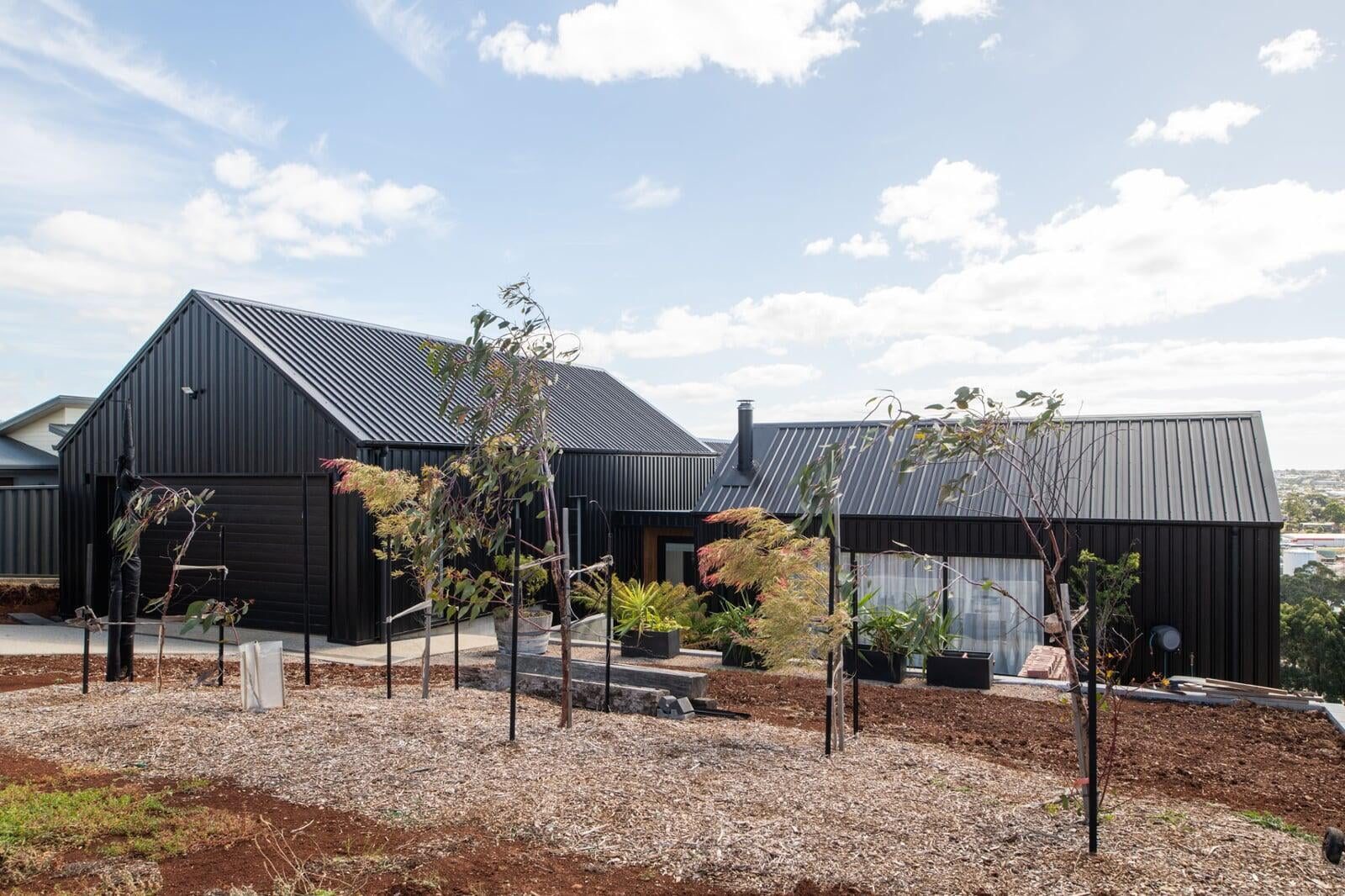
For custom home builders, Hobart presents a genuinely distinct brief. The topography is challenging — and extraordinary. Sites with views over the Derwent, Bruny Island, or the mountain rarely exist without steep access, hillside footings, or complex earthworks. But the results, when done well, are homes that couldn't exist anywhere else. Hobart's best custom homes aren't just houses — they are responses to one of Australia's most dramatic urban settings.
The City of Hobart LGA has a population of approximately 55,000, with the Greater Hobart area reaching 247,086 as of the 2021 census. Inner suburbs — Sandy Bay, Battery Point, South Hobart, West Hobart, and New Town — attract buyers drawn to walkability, heritage streetscapes, and proximity to the CBD's growing food and cultural scene. The Eastern Shore — Lindisfarne, Rokeby, Bellerive — offers larger blocks, newer infrastructure, and a different, quieter character.
A Note on Our Service Area
Davies Design & Construction is based in Sheffield, north-west Tasmania — approximately 267 kilometres from Hobart. We build across northern Tasmania, but Hobart is beyond our regular service area. We can still help: for Hobart projects, we refer clients to Align Architecture & Interiors, a Hobart practice with a shared commitment to design-led, high-performance residential construction. Get in touch and we'll connect you with the right people for your project.
Why People Choose Hobart
kunanyi / Mount Wellington
The mountain defines Hobart in ways that few Australian cities can match. From snow in winter to summer bushwalking, and a 360-degree summit panorama over the city, the Derwent, and the Southern Ocean — it is an extraordinary civic backyard. Properties with mountain views carry a permanent premium.
MONA & the Arts
MONA transformed Hobart's cultural identity from the moment it opened in 2011. The city now has a year-round arts calendar — Dark Mofo, MONA FOMA, the Wooden Boat Festival, and the Taste of Tasmania — that attracts visitors and underpins a hospitality and cultural economy unlike anything in Tasmania's north.
Strong Property Fundamentals
After an extraordinary growth cycle, Hobart's property market has entered a more stable phase with genuine underlying demand. Interstate and overseas migration continues, the UTAS presence brings student and academic demand, and the Antarctic science sector employs a highly educated, high-income cohort that underpins quality property values.
Antarctic & Science Hub
Hobart is Australia's Antarctic gateway — home to the Australian Antarctic Division, the CSIRO's marine and atmospheric research, and a cluster of science and research institutions that bring skilled professionals and significant economic activity to the city and its property market.
Diverse Neighbourhoods
From Battery Point's Georgian streetscapes to Sandy Bay's prestige waterfront, North Hobart's restaurant strips to the family-focused Eastern Shore suburbs — Hobart offers genuine neighbourhood diversity across a geographically compact urban area. You can find exactly the right setting for almost any lifestyle brief.
Topography & Views
Hobart's hillside suburbs — West Hobart, Mount Nelson, Lenah Valley, Fern Tree — offer elevated positions with views that are genuinely world-class. The challenge and the opportunity are the same thing: a sloped site with a Derwent view, done well, produces a home of permanent distinction. Done poorly, it becomes a project liability.
What to Know About Building in Hobart
Building in Hobart is governed by the City of Hobart Local Provisions Schedule (LPS), which commenced on 22 October 2025 — making the City of Hobart one of the first Tasmanian councils to adopt a full LPS under the Tasmanian Planning Scheme. Applications are lodged with the City of Hobart via PlanBuild Tasmania, the state government's online planning portal, which went live for Hobart applications in August 2024. Key things to understand before you build:
- The City of Hobart LPS controls land use, height limits, setbacks, and design standards. The framework replaced the earlier Hobart Interim Planning Scheme, bringing Hobart's planning rules into alignment with the statewide Tasmanian Planning Scheme.
- Heritage overlays are extensive across inner Hobart — Battery Point, Sullivan's Cove, North Hobart, and parts of South Hobart and West Hobart all carry significant heritage protections. Any site within a heritage precinct requires careful pre-application consultation to understand what the LPS and heritage guidelines actually permit.
- Hillside sites in West Hobart, Mount Nelson, Lenah Valley, and Fern Tree may fall within Bushfire Prone Land — triggering BAL (Bushfire Attack Level) assessments that affect construction methods and material specifications. BAL-rated construction adds cost but is essential for life safety.
- Hobart's topography means a significant proportion of desirable sites involve cut-and-fill, retaining walls, or stepped footings. Detailed geotechnical assessment is essential before design commences — the site conditions dictate the engineering, and the engineering drives a material part of the build cost.
- Derwent estuary and coastal sites face salt-air exposure, particularly in suburbs like Lindisfarne, Bellerive, and Howrah on the Eastern Shore. Marine-grade material specification for cladding, roofing, and hardware is not optional on these sites.
- UTAS campus consolidation in the Hobart CBD is ongoing, with potential to reshape some inner suburban land parcels. The planning environment around UTAS-adjacent sites is worth monitoring for those considering infill development or subdivision.
These are the considerations that separate a well-prepared Hobart project from one that discovers problems after contracts are signed. An experienced Hobart architect or design-and-build firm will know all of them — and will ask the right questions before you commit to a site or a concept.
Hobart Building FAQ
Does Davies Construction build homes in Hobart?+
How much does it cost to build a custom home in Hobart?+
What is the City of Hobart planning scheme for new builds?+
What are the best areas in Hobart for a new custom home?+
Can Davies Construction help with my Hobart build enquiry?+
Also building in
North-West Coast & Hinterland
Tamar Valley & Launceston
Midlands & East Coast
Southern Tasmania