Burnie is one of Tasmania's most underrated locations to build a custom home. Affordable land, strong rental fundamentals — with some suburbs delivering yields up to 9.9% — and a genuinely liveable coastal city on the cusp of significant infrastructure investment. Here's a practical breakdown of what it actually costs to build in Burnie in 2026.
Burnie in 2026: Why the Numbers Stack Up
Burnie is Tasmania's major north-west port city, population 20,433 (2025 LGAT estimate), positioned on the Bass Strait coast with Wynyard Airport just 17 kilometres west. It's a working city — port, healthcare, education, manufacturing — with the University of Tasmania's West Park campus (opened 2021) adding students and a creative undercurrent to its industrial identity.
For investors, the fundamentals are hard to ignore. Some Burnie suburbs have recorded rental yields up to 9.9% — driven by strong tenant demand from healthcare workers at the North West Regional Hospital, university students, and government employees, set against relatively affordable purchase prices. That gap between land cost and rental return is the defining feature of the Burnie investment case.
The city is also mid-transition. The Northern Cities Major Development Initiative has leveraged $782M in investment (from a $90M state seed commitment) into Burnie's infrastructure and amenity. The Burnie Primary School is undergoing a major redevelopment through to 2030 — a clear signal that families are arriving and long-term confidence is strong. The Port of Burnie secured a 30-year operating lease in October 2025, handling over five million tonnes per year, cementing its role as Tasmania's primary freight gateway.
The single largest catalyst on the horizon is the Marinus Link — the $3.9B undersea electricity interconnector between Tasmania and Victoria, with its Tasmanian landing point at Heybridge, approximately 9 km south-east of Burnie on the Bass Highway. Construction is starting in 2026, with the project expected to create over 1,400 direct Tasmanian jobs. For the Burnie economy, this is a generational infrastructure event: sustained employment, population pressure, and long-term confidence in the north-west corridor. For owner-occupiers looking to build, the value proposition is equally compelling: land that lets you direct serious budget into the quality of the build itself, at price points simply not available in Hobart or on the mainland.
Build Costs Per Square Metre in Burnie (2026)
Custom home build costs in Burnie in 2026 are broadly in line with northern Tasmania generally. All Tasmanian builds carry a Bass Strait freight premium of 10–20% on building materials versus mainland states — this is unavoidable and is already factored into any reputable Tasmanian builder's square-metre rates. As a rough orientation for custom builds:
- Entry-level custom homes (standard finishes, simple geometry, modest specification): $3,200–$3,800/m²
- Mid-range custom builds (quality finishes, architect-designed, considered specification): $3,800–$4,800/m²
- High-specification builds (high-performance envelope, premium materials, complex design): $4,800–$5,500/m² and above
Davies Design & Construction's custom home builds typically sit in the $3,500–$5,500/m² range — reflecting our integrated design-and-build model, high-performance construction standards, and the genuine complexity that custom architecture involves. The square-metre rate is a rough orientation tool only. The real determinants of your final cost are site conditions, design complexity, and specification level — not a single $/m² figure divorced from those variables.
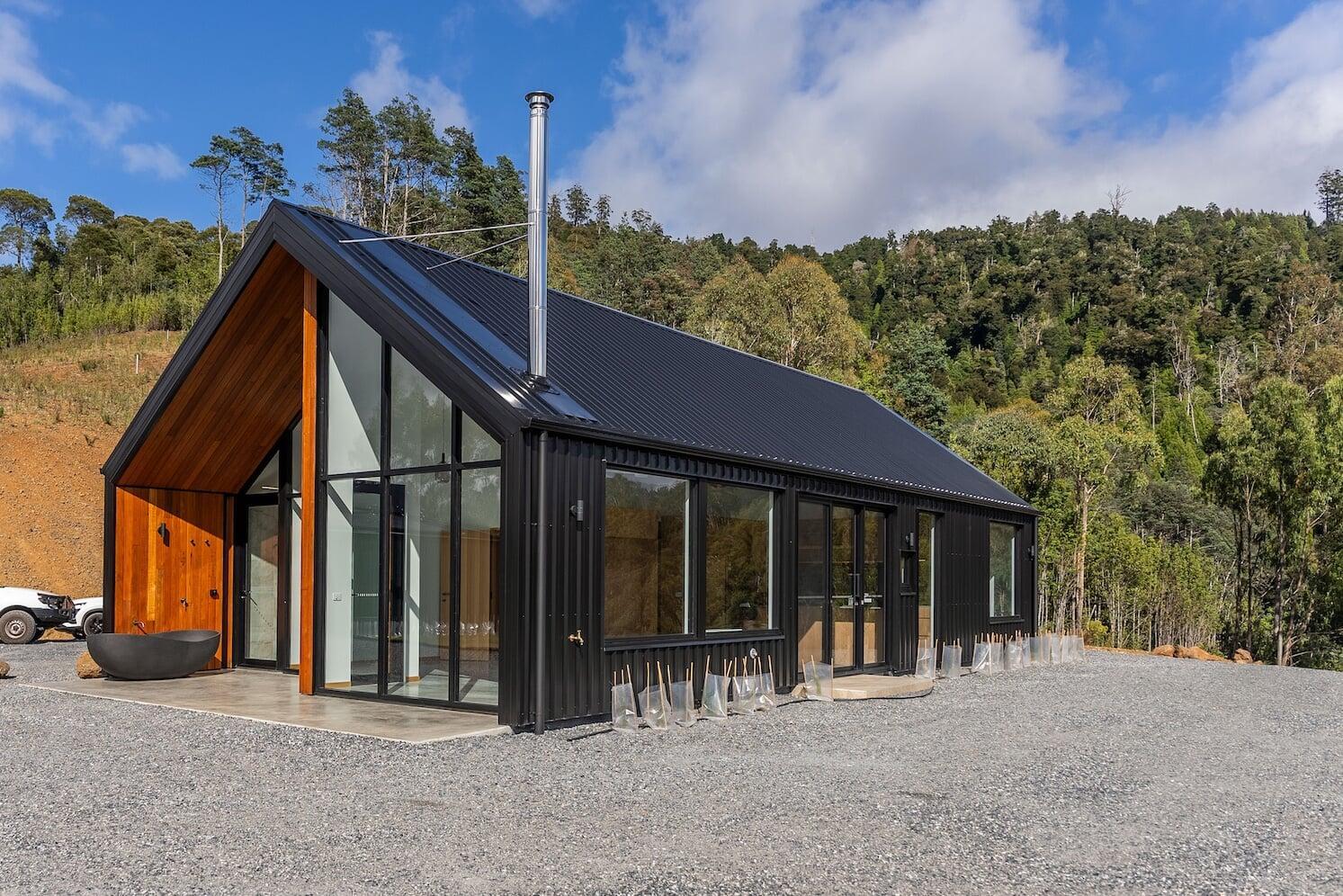
Burnie's trade and labour pool is well-established for a regional city — we work with local tradespeople across the north-west and there's no learning curve. Our award-winning Barn House Penguin, built between Burnie and Devonport, is a demonstration of what this region's trades team can deliver at a high standard.
Land Prices in Burnie 2026
Burnie offers some of the most affordable residential land on Tasmania's north coast — and that affordability is one of the key drivers of the strong investor yields the city records. Prices vary meaningfully by suburb, elevation, and proximity to the water and CBD. As a general guide:
- Elevated suburban positions (Park Grove, South Burnie): Elevated blocks with Bass Strait views command a premium within Burnie. These hillside positions offer outlook and passive solar orientation, but they require site-specific engineering — retaining walls, stepped footings, or cut-and-fill earthworks — that adds to construction cost. Premium within the Burnie market, still affordable by Tasmanian standards overall.
- Coastal and flat suburbs (Cooee, East Burnie, Somerset): Coastal frontage and proximity to Bass Strait come with both appeal and construction considerations (marine-grade material specifications). Somerset — just west of Burnie on the Cam River — offers pleasant coastal lifestyle and easy highway access.
- Inland residential (Romaine, Acton, Park Grove surrounds): Romaine and neighbouring Acton offer quiet, family-oriented residential land further from the coast. These tend to represent the most affordable entry point within the City of Burnie. Romaine Primary School opened in 2012 and Romaine Reserve provides 12 hectares of native bushland.
- Wynyard and surrounds (Waratah-Wynyard Council, 17km west): Wynyard — a separate township with Burnie Airport and an attractive town centre — is worth comparing. It sits within the Waratah-Wynyard Local Provisions Schedule (commenced 19 April 2023), which operates differently to Burnie City Council. Our Wynyard area guide covers that market in detail.
For current listings and site-specific pricing, we'd recommend speaking with a local Burnie agent — land market conditions change, and a buyer's due diligence on a specific allotment is always essential before committing.
Total Budget: A Practical Example
A realistic custom home build in the Burnie area in 2026 for an investor-grade property: a well-designed 180–200m² custom home at $4,000–$4,400/m² ($720,000–$880,000), plus site costs, permits, consultants, and landscaping — build and ancillaries in the range of $850,000–$1,100,000 depending on site and specification (land cost additional, typically $100,000–$280,000 for a well-located residential block).
For an owner-occupier build with a more considered specification and a mid-range coastal position: the all-in number for a quality 200–220m² home — land, build, site works, and ancillaries — typically runs $1,000,000–$1,300,000. Given Burnie's land affordability, a higher proportion of that budget can be directed into the quality of the build itself compared to equivalent spending in Hobart or Launceston.
Burnie-Specific Cost Drivers
Every site in Burnie has its own cost profile. The factors that most significantly affect build cost in this area are:
- Coastal exposure and marine-grade specification: Burnie's direct Bass Strait position means salt air is a genuine design consideration for the entire city. All coastal and near-coastal builds require marine-grade material specification — cladding, roofing, fixings, and hardware. This is standard practice for Davies on any north-west coast project, and it's a cost that protects your home over decades.
- Elevated sites and site engineering: Park Grove and South Burnie's elevated positions — attractive for views and passive solar — require retaining walls, stepped footings, or split-level design. Our guide to building on a slope in Tasmania covers what this adds and how to manage it. Budget $30,000–$100,000+ for site-specific engineering on a significantly sloped allotment.
- Coastal wind loading: Burnie faces prevailing north-westerlies directly off Bass Strait. Wind loads affect structural design, glazing specifications, and external material choices. A well-designed high-performance building envelope — airtight and super-insulated — handles Bass Strait conditions and delivers dramatically lower heating costs through Burnie's cooler winters.
- Services connection: Established Burnie suburbs are generally well-serviced by TasWater reticulated water and sewerage, NBN, and power. Outer or rural-adjacent lots may require on-site wastewater systems — confirm per allotment with Burnie City Council or TasWater before purchasing.
- Energy performance — the long-term payback: Burnie's cooler climate (average winter temperatures 5–12°C, direct coastal wind exposure) makes a high-performance building envelope a compelling investment. The payback on upgraded insulation, airtightness, and double or triple glazing is faster here than in most Australian cities. See our guide to energy efficient homes in Tasmania.
The Pre-Construction Costs
Beyond land and construction, every Burnie build project involves pre-construction costs that must be planned for. Under the Building Act 2016 (Tas), applications are lodged with and assessed by Burnie City Council. Burnie City Council was the first council in Tasmania to implement the Tasmanian Planning Scheme (Local Provisions Schedule commenced 22 July 2020), which means the planning framework here is mature and well-understood. Permitted development applications are typically assessed within 28 days.
- Planning and building permit fees — typically $2,000–$5,000 combined for a residential build
- Structural engineering — typically $3,000–$6,000 for a standard residential project
- NatHERS energy assessment — typically $1,000–$2,000
- Surveying (feature and level survey, soil testing, title re-establishment) — $3,000–$5,000
- Site costs (clearing, earthworks, driveway, services connections) — $15,000–$80,000+ depending on site conditions; elevated blocks at the higher end
- Landscaping (fencing, outdoor areas, gardens) — $20,000–$60,000 depending on scope
When we present a project budget estimate, all of these costs are included. Nothing should be a surprise at handover.
First Home Buyer Incentives (2026)
Two significant changes to first home buyer incentives took effect on 1 July 2026:
- First Home Owner Grant (FHOG): Reduced from $30,000 to $20,000 effective 1 July 2026 (valid through 30 June 2027) for eligible new homes. Burnie's affordable land prices make the FHOG a meaningful contribution to a first home build budget in this market.
- Stamp duty exemption for established homes: This concession ended on 30 June 2026. Full stamp duty now applies to established home purchases. This reinforces the relative advantage of building new: the FHOG still applies to new construction, while the exemption on established homes has concluded.
- Cannot claim both: Buyers must choose the FHOG or stamp duty relief — not both. For most first home buyers building new in Burnie, the FHOG is the relevant concession. Confirm eligibility with the State Revenue Office Tasmania at the time of your application.
Our detailed guide to the First Home Owner Grant Tasmania 2026 covers eligibility and the application process in full.
Burnie vs Launceston and Devonport
Build costs per m² in Burnie are broadly comparable to Launceston and Devonport — the Bass Strait freight premium affects all of northern Tasmania equally. What differentiates the three cities is land cost, market depth, and the specific cost drivers for each area:
- vs Launceston: Launceston's larger population (85,000+ city, 160,000+ metro) creates greater market depth and generally stronger capital growth. Land prices in inner Launceston exceed Burnie for equivalent positions. Burnie's rental yields are typically stronger. See our Launceston cost guide for comparison.
- vs Devonport: Devonport is our home region — Sheffield is 29 km from Devonport. Land prices and build costs are broadly comparable between the two cities. Devonport has the Spirit of Tasmania ferry terminal and the $240M Spirit Quay redevelopment underway. Burnie has the port, the university campus, and consistently stronger gross rental yields. See our Devonport guide for that market.
Our full guide to building costs across Tasmania covers the statewide picture if you're comparing locations before deciding where to build.
Building in Burnie with Davies
Davies Design & Construction has been building across north-west Tasmania since 2009. Our Sheffield base is approximately one hour south-east of Burnie — Burnie and the wider north-west coast are firmly within our service area. We've built award-winning homes in this coastal environment, including our Barn House Penguin between Burnie and Devonport, and we have established relationships with trades and suppliers across the region.
We offer the full range of services for Burnie builds: custom homes in Burnie, renovations and extensions, and demolition services. Whether you're planning a first build, an investment property, or an owner-occupier home on a north-facing coastal block, we bring the same high standards we apply across all of our builds.
The best place to start is a feasibility conversation. Bring your site details, your rough budget, and your vision — we'll give you an honest picture of what's achievable and what it will actually cost. We don't charge for initial feasibility discussions, and there's no obligation.
Get in touch to start the conversation. Published August 2026.
About the Author
Luke Davies
Luke is the founder of Davies Design & Construction and author of Dream Home. He writes about home design philosophy, lean construction, and building businesses that put people first.
0 Comments
Related Articles