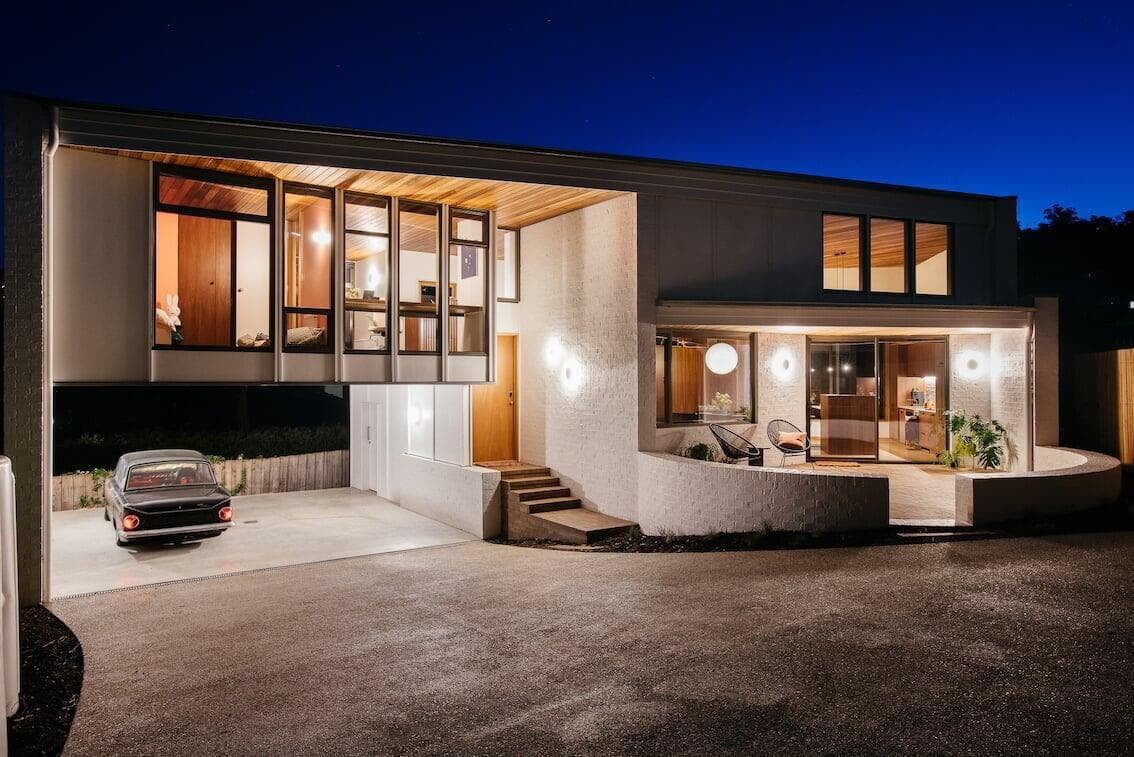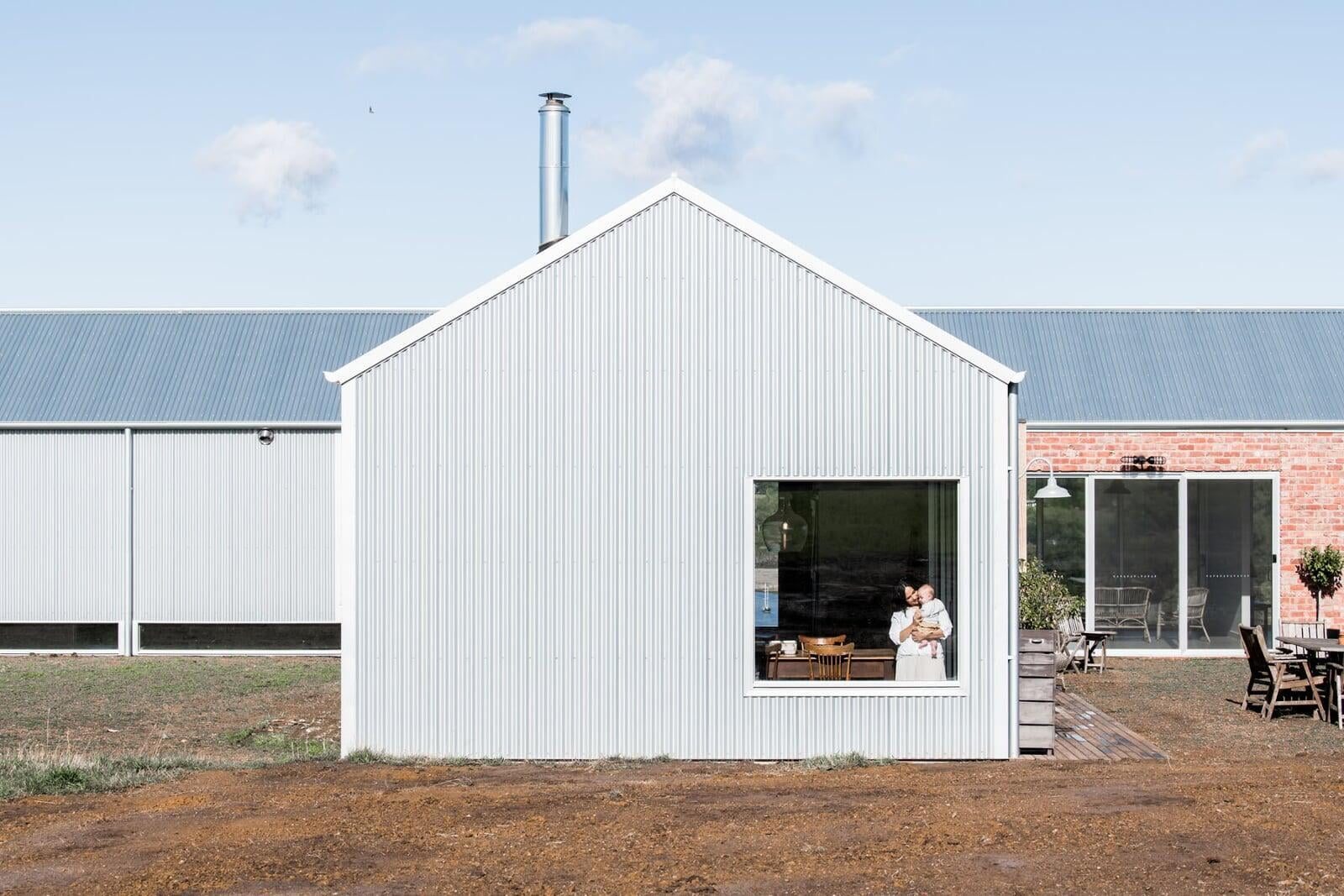
In June 2026, a small brushed-steel plaque was mounted on the timber wall of a home in the Sheffield foothills. It reads: Certified Passive House — Passive House Institute. It took years of research, a meticulous design process, a precision construction team, and independent verification to earn it. For Diane and Stephen — the homeowners — it is the culmination of a decade of planning. For Davies Design & Construction and Align Architecture, it is a milestone in what's possible in Tasmanian residential building.

Mill Corner Longhaus — The Project
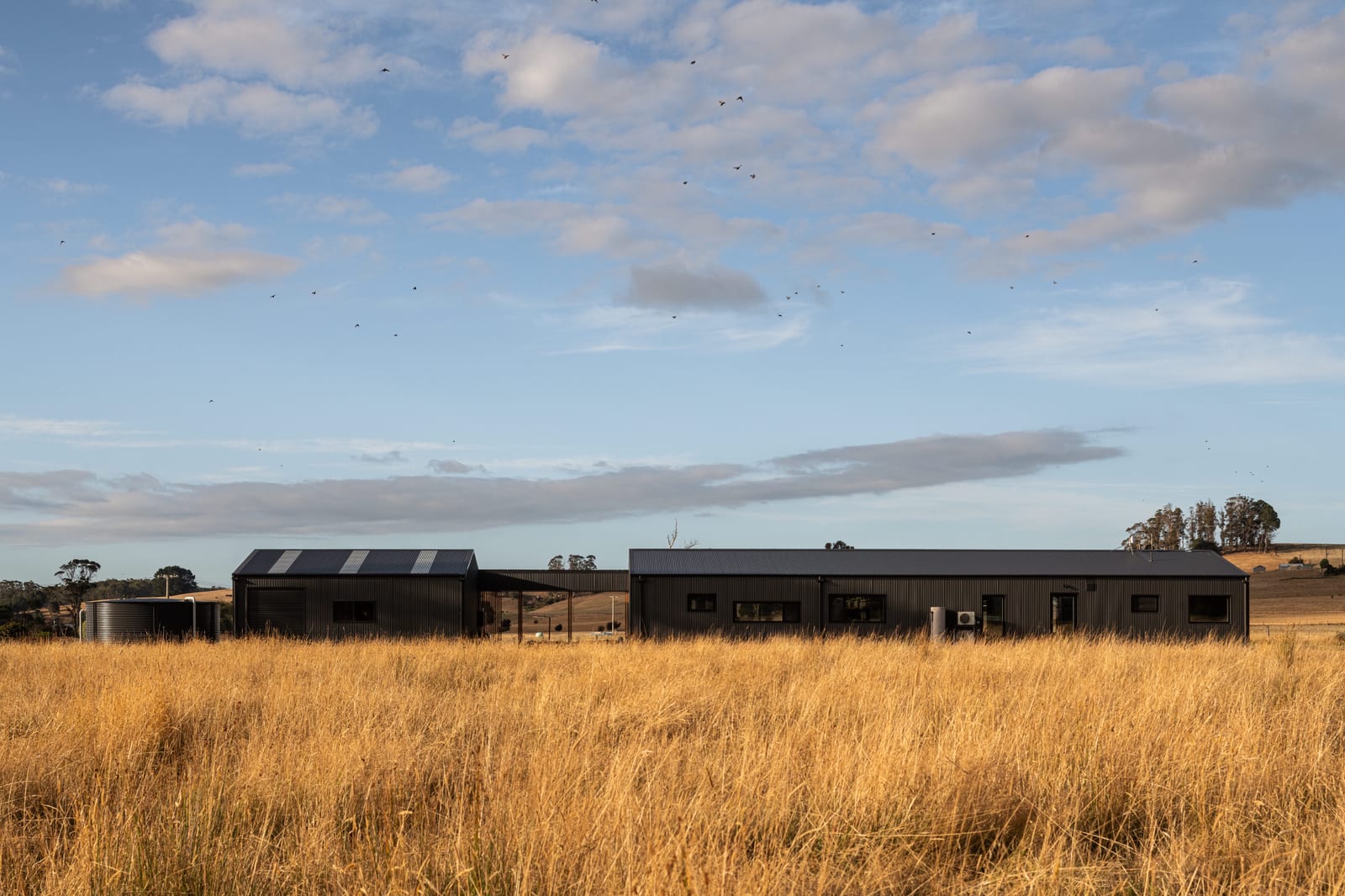
Perched on an elevated rural block in the Sheffield foothills with commanding views of Mount Roland and the Badgers Range, Mill Corner Longhaus is a 198m² certified Passivhaus that includes a 50m² self-contained accommodation wing. Designed by Align Architecture & Interiors and built by Davies, it takes the form of a low-slung linear 'longhaus' oriented due north — a shape that maximises solar gain in Sheffield's cold winters while sheltering the courtyard from prevailing westerly winds.
The brief was clear from the first conversation: certified Passivhaus, universally accessible, designed to serve Diane and Stephen well into retirement. The project page on this site covers the design, materiality, and construction approach in detail — read the full project story here. You can also follow along on the Mill Corner Longhaus Facebook page, where Diane and Stephen document their life in Australia's most airtight home.
What the Certification Means
Passivhaus certification is issued by the Passive House Institute in Darmstadt, Germany — the same body that wrote the standard — after independent third-party verification that a building meets five simultaneous performance criteria: space heating demand, heating load, primary energy demand, airtightness below 0.6 ACH@50Pa, and thermal comfort in all seasons. The building is modelled using PHPP (Passive House Planning Package) and then pressure-tested on site. Certification is only issued if the tested result matches the model.
Most builders who claim to build "passive house inspired" or "high performance" homes have never been through this process. Mill Corner Longhaus has — and it passed with one of the best airtightness results ever recorded for a residential building in Australia.
0.18 ACH — The Number That Defines It
The Passivhaus standard requires airtightness below 0.6 air changes per hour at 50 Pascals of pressure (0.6 ACH@50Pa). Mill Corner Longhaus achieved 0.18 ACH@50Pa — more than three times better than required, and among the tightest results ever recorded for a residential building in Australia.
What does this mean in practice? It means that at 50 Pascals of pressure — roughly equivalent to a 30 km/h wind pushing against every surface of the house simultaneously — less than one-fifth of the interior air volume escapes in an hour. In a standard Australian home, uncontrolled air leakage is responsible for 25–40% of heating and cooling energy. In Mill Corner Longhaus, it is effectively eliminated.
Achieving this result requires obsessive attention at every junction: every penetration sealed, every membrane lapped and taped, every service entry detailed as a potential failure point. It is the kind of construction discipline that cannot be retrofitted — it has to be built into the process from the first day on site.

Six Months of Real-World Performance
Certification is based on modelled performance. Real life is messier than a model. After six months of living in the house, Stephen ran the numbers and compared them to the PHPP predictions. The results:
| Metric | PHPP Model | 6-Month Actual |
|---|---|---|
| Heating demand | ≤15 kWh/m²a | 16 kWh/m²a (8.7 kWh/day) |
| Heating load | ≤10 W/m² | 9 W/m² (1.7 kW peak) |
| Cooling demand | — | 4 kWh/m²a (2.2 kWh/day) |
| Total household energy | 21.7 kWh/day | 17.5 kWh/day |
| Solar generation (11 kW array) | 41 kWh/day avg | 48 kWh/day |
| Grid draw | — | 5% of total |
The headline number: total household energy consumption is running at 17.5 kWh per day — 19% below the PHPP-modelled figure of 21.7 kWh/day. The solar array, meanwhile, is producing nearly three times the energy the house requires, and only 5% of household energy has been drawn from the grid across the first six months.
The peak heating load of 1.7 kW is worth pausing on. A standard 198m² home in the Sheffield climate would typically require a 10–20 kW heating system to maintain comfort in winter. Mill Corner Longhaus achieves the same result with a system smaller than a domestic hairdryer running continuously — because the building envelope itself does most of the work.
The Passivhaus Experience — Staying in the Wing
The 50m² self-contained accommodation wing is more than a granny flat. Built to the same Passivhaus standards as the main dwelling — the same airtight envelope, the same MVHR ventilation, the same triple-glazed windows — it offers guests an experience that is genuinely difficult to find anywhere in Australia: a night or a week inside a certified Passivhaus, with Mount Roland framing the view and the temperature sitting at a steady 20–22°C regardless of what's happening outside.

Diane and Stephen are making the wing available to guests who want to experience Passivhaus living firsthand before committing to building their own. If you're curious about the standard but want to feel it rather than just read about it, this is a rare opportunity. Follow the Mill Corner Longhaus Facebook page for availability updates.
What This Means for Davies — and for Your Project
Mill Corner Longhaus is the first home Davies has taken through the full Passivhaus certification process from design through to certification plaque — and it won't be the last. Every element of that process has been documented, refined, and embedded in the way we approach high-performance builds going forward.
The integration of Align Architecture and Davies under one roof is not incidental to this result — it is the reason for it. Passivhaus certification requires architecture and construction to be a single continuous process, not two sequential handoffs. When the PHPP model, the construction drawings, and the site team are all working from the same set of targets, achieving 0.18 ACH is a result of discipline, not luck.
If you are considering a certified Passivhaus — or a high-performance home built to those principles without formal certification — we'd welcome the conversation. You can read more about our approach on the Passivhaus page, or read our guide to passive house building in Tasmania. When you're ready to talk, reach out here.
Last updated: June 2026. Performance data provided by the homeowners after six months of occupancy.
About the Author
Luke Davies
Luke is the founder of Davies Design & Construction and author of Dream Home. He writes about home design philosophy, lean construction, and building businesses that put people first.
0 Comments
Related Articles