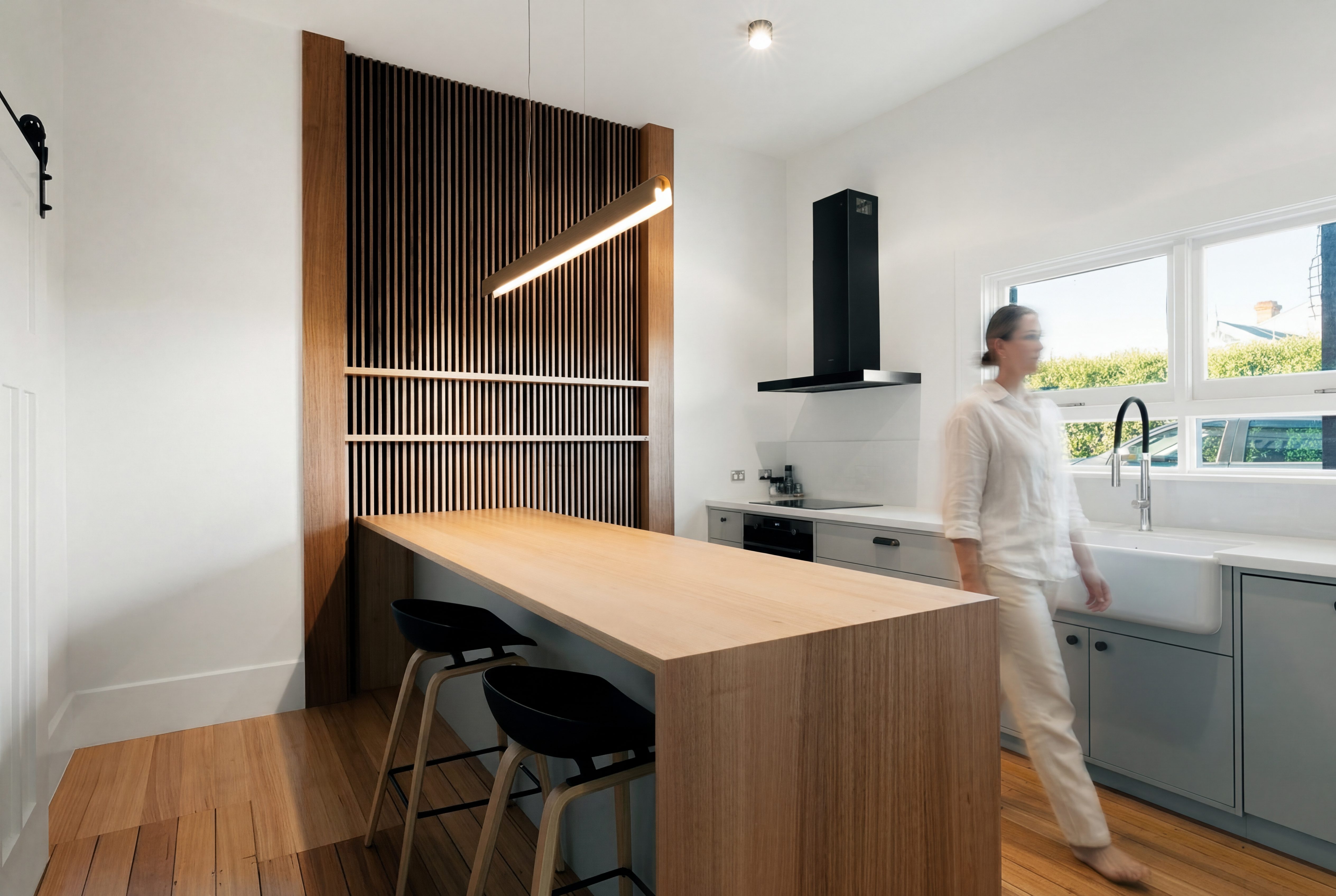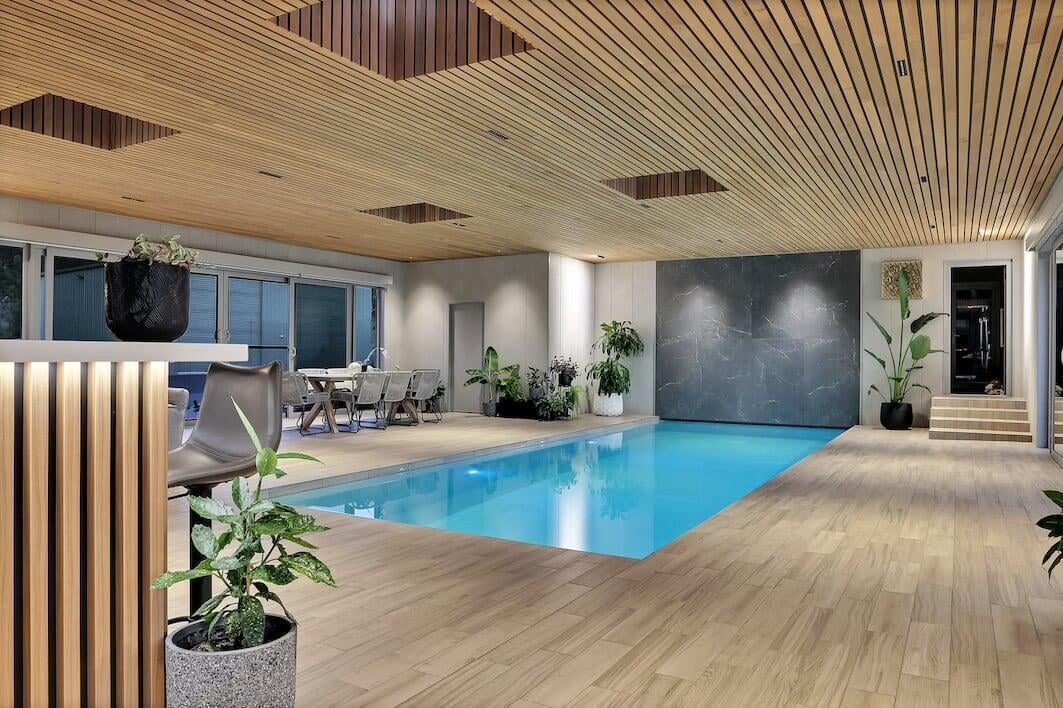
Custom joinery and built-in cabinetry are where a new home's design moves from plan to character. Shelving, robes, entertainment units, kitchen cabinetry, window seats, and study nooks built to the exact dimensions of the room are what distinguish a genuinely custom home from a project home that uses standard modules wherever they fit. In Northern Tasmania, joinery is also a meaningful reference to the local timber tradition — and understanding how each element is specified, priced, and installed helps you get the most from your joinery budget.
What "Built-In Joinery" Covers
In a new residential build, joinery refers to all fixed timber and board products made by a joiner (cabinetmaker) and installed into the building — distinct from structural carpentry (framing) and site-applied trim (architraves, skirtings). Built-in joinery includes:
- Kitchen cabinetry: Floor-to-ceiling or standard-height cabinets, drawers, and overhead units forming the kitchen work zone. The most significant joinery scope by value in most homes.
- Wardrobe and robe systems: Built-in hanging rails, shelving, and drawers in bedrooms. Walk-in robes with custom layouts versus reach-in robes with sliding door fronts are both joinery scope.
- Bathroom vanities: Custom-made vanity units, mirror cabinets, and storage towers are joinery items. Many bathroom vanities are semi-custom (standard carcass, custom doors) rather than fully bespoke.
- Laundry joinery: Trough surround, broom cupboard, built-in ironing board, overhead cabinets.
- Entertainment and media units: Built-in TV niches, floating shelving, media cabinetry with cable management.
- Study and library joinery: Built-in desks, bookshelves, display cabinets, window seats with storage below.
Cabinet Construction — Board Types and Quality Indicators
The carcass (box) of a cabinet is almost always made from a sheet board product. The choice of board type is the primary quality differentiator in a cabinetry quote:
- Moisture-resistant (MR) MDF or particle board: The standard carcass material for kitchen and bathroom cabinetry in Australian residential construction. MR board is manufactured with a moisture-resistant resin binder — it handles incidental moisture (steam, cleaning) better than standard board but is not waterproof. Look for MR board in any cabinet within a wet zone. Non-MR board in a kitchen or bathroom will swell and delaminate at any point of water contact over time.
- Standard MDF or particle board: Appropriate for dry areas — wardrobes, bookshelves, entertainment units, study desks. Less expensive than MR board and performs identically in a dry environment.
- Plywood carcass: 18 mm structural plywood (marine ply or birch ply) is the premium alternative. Significantly stronger than particle board or MDF, with better screw-holding capacity for drawer slides, hinges, and shelf pins. More dimensionally stable under humidity cycling. Costs approximately 30–50% more than particle board for equivalent joinery, but produces cabinetry that outlasts the house in most cases. Common in high-specification custom homes and where the carcass interior will be visible (open shelving, glass door display cabinets).
Door and Drawer Front Finishes
The front face of a cabinet — the visible surface the client touches and sees every day — is specified separately from the carcass. Common finish options:
- Melamine / vinyl wrap: A resin-impregnated paper or PVC film bonded to an MDF substrate. Wide colour and texture range, consistent finish, lowest price point. Quality varies significantly — specify the specific product and brand (Laminex, Polytec, or equivalent), not just the category. Thermofoil (vinyl wrap) around a routed profile or edge detail is the standard "painted look" door in the mid-range market.
- Polyurethane (2-pac): A two-component polyurethane paint applied by spray in a factory environment, sanded to a smooth substrate, and buffed to a consistent gloss or satin level. The premium painted finish for kitchen cabinetry — extremely hard, chemical-resistant, repairable, and consistent in large colour ranges. Costs approximately 20–40% more than vinyl wrap for equivalent doors. Specify 2-pac for kitchen doors where high-use durability is a priority.
- Timber veneer: A thin slice of real timber (0.5–1.5 mm) bonded to an MDF or ply substrate. Provides genuine timber grain character without the movement, cost, or weight of solid timber. Available in Tasmanian species (blackwood, myrtle, oak) and imported timbers. A specialist finishing lacquer or oil is required to protect the veneer surface. Veneer doors in a kitchen are higher maintenance than 2-pac but cannot be replicated in character.
- Solid timber doors: Used for feature doors, drawer fronts, and open shelving faces in higher-specification homes. Tasmanian blackwood and myrtle are available from local mills and carry significant character. Solid timber requires allowance for seasonal movement — door frames must be designed with tolerance gaps, and solid timber is not appropriate for fully enclosed cabinet doors in a moisture-prone environment. Best used selectively as a feature, combined with painted carcass and other fronts.
Hardware — The Difference Between Good and Excellent Joinery
Hardware selection is where the feel of a cabinet is determined — the weight of a drawer pull, the closing speed of a soft-close hinge, the extension length of a drawer slide. Specifying European hardware from established manufacturers is the most reliable way to ensure long-term performance:
- Blum (Austrian): The benchmark for cabinet hardware in Australian residential construction. Blum Tandembox drawer systems, Legrabox runners, and Clip-top hinges are industry standards for mid- to high-specification kitchens. Blum hardware is tested to 500,000 open/close cycles — meaningfully longer than alternative products at similar price points. Tandembox and Legrabox are full-extension drawer systems with integrated soft-close and push-to-open options.
- Hettich (German): Direct Blum competitor with comparable quality. ArciTech drawer systems and Innotech runners are widely specified in Australian residential joinery. A cabinetmaker committed to Hettich hardware is producing high-quality work — the brand choice matters less than the commitment to a major European manufacturer.
- Handles and pulls: The physical handle is the most-touched element of any cabinet. Specify handles that are fixed with two fixing points (not single-screw handles) for anything other than a drawer on a low cabinet — single-point fixings loosen over time under lateral load. Specify matt black, brushed nickel, or brushed brass powder-coated or PVD-finished handles for durability — chrome plating chips; lacquered brass oxidises.
- Soft-close everywhere: Soft-close hinges and drawer runners are now the expected standard on any professionally made cabinet. The cost premium over non-soft-close hardware is minimal (less than $10 per door or drawer) and the quality signal — to owners, guests, and future buyers — is significant.
Cabinet Heights and Standard Dimensions
Australian cabinetry is manufactured to industry-standard dimensions that correspond to standard benchtop and appliance sizes:
- Kitchen bench height: 900 mm is the Australian residential standard, set by the combination of a 720 mm cabinet carcass + 33 mm leg leveller clearance + 12 mm board thickness + 20 mm stone or 40 mm timber benchtop. A taller owner (over 185 cm) benefits from 950 mm bench height — in a custom home, this is a simple dimensional change that requires no special ordering and costs nothing extra to specify.
- Overhead cabinet height: 720 mm high × 300 mm deep is the Australian standard overhead. Floor-to-ceiling overhead cabinets — extending from 720 mm to the ceiling line — provide maximum storage but require ceiling-height consistency. Where the ceiling height varies (raked ceiling, coffered ceiling), floor-to-ceiling cabinets require individual dimension surveying after frame stage.
- Bathroom vanity height: 850–900 mm is the contemporary Australian standard for a wall-hung or floor-standing vanity (replacing the older 750 mm standard). A higher vanity reduces back strain for taller users. In an accessible design (AS 1428.1), the maximum knee clearance under a wall-hung vanity is 700 mm — confirm accessible design requirements with your building designer before specifying vanity height.
- Walk-in robe layout: Standard hanging rail height is 1,800 mm (from floor to rail) for long hanging, 1,050 mm for short hanging (shirts, jackets) with a shelf above. A double-hanging configuration (two rails stacked) fits within a 2.1 m floor-to-ceiling height with a shelf above the upper rail. Plan for at least 600 mm of clear floor depth in front of a hanging section to allow for clothing depth (600 mm) plus circulation.
Benchtop Materials — Kitchen and Bathroom
The benchtop sits on top of the cabinetry and is specified separately from the cabinet carcass. The main options for a Tasmanian new build:
- Engineered stone (Caesarstone, Silestone, Quantum Quartz): The dominant kitchen and bathroom benchtop material in Australian residential construction. Consistent surface, high scratch and stain resistance, wide colour range, non-porous. Available in thicknesses from 20 mm (standard) to 40 mm (waterfall edge, feature). Important: from 1 July 2024, fabrication of engineered stone in Australia requires Respirable Crystalline Silica (RCS) controls — verify the fabricator's WorkSafe compliance before engaging.
- Natural stone (granite, marble, quartzite): Genuine stone requires periodic sealing (marble — annually; granite — every 3–5 years) and is more susceptible to etching (acids: lemon juice, vinegar, red wine on marble) than engineered stone. The character of natural stone — movement, variation, veining — cannot be replicated. For a Tasmanian home with a feature kitchen, natural stone is a long-term investment that improves in character with age. Specify the stone from the slab in person — digital images are inadequate for natural stone selection.
- Timber benchtop (Tasmanian hardwood): Blackwood, myrtle, Tasmanian oak, and celery top pine are all used as kitchen benchtops. Timber requires regular oiling (food-safe oil, 2–4× per year) and is susceptible to water damage at sink and stovetop cutouts if not correctly edge-sealed and maintained. In a dry northern Tasmanian climate with good ventilation, a well-maintained timber benchtop is a lifetime investment with genuine regional character. Not suitable as a bathroom benchtop without sealed ends and a recessed sink — surface water will penetrate the end grain and cause staining.
- Compact laminate (Laminex Compact, Formica): A solid-through laminate material (colour extends through the full thickness) used for benchtops, shelving, and locker surfaces. High moisture resistance, lightweight, low cost. The entry-level specification for laundry and secondary bathroom benchtops. Not the right product for a high-use kitchen where a stone or timber surface is the expectation.
Specifying Joinery for Your New Home — What to Include in the Brief
The clearest briefs produce the most accurate quotes and the fewest variations. When briefing joinery for a new home, specify:
- Room-by-room scope: Which rooms include joinery? List each room and what is included — kitchen cabinets, vanity, robe, entertainment unit, desk.
- Carcass material: MR board or plywood. Plywood adds cost; specify it for kitchens and bathrooms if budget allows.
- Door and drawer front finish: Vinyl wrap, 2-pac, veneer, or solid timber — and the specific product/colour reference.
- Hardware brand: Blum or Hettich. Soft-close required throughout.
- Benchtop material and thickness: Engineered stone (brand, colour, thickness), natural stone, or timber.
- Handles: Provide a product reference or a finish specification (matt black, brushed nickel) and confirm the fixing type.
For more on kitchen design in a new Tasmanian home, see our guide on kitchen design for new homes in Tasmania.
Frequently Asked Questions
How much does built-in joinery cost in a new Tasmanian home?
Joinery is one of the most variable budget items in a new custom home, because the scope, materials, and hardware quality span a very wide range. As a rough guide: a complete kitchen joinery package (cabinets, benchtop, hardware — excluding appliances) for a mid-specification 4-bedroom home ranges from $25,000 to $60,000+. Full-home joinery including kitchen, bathrooms, laundry, and robes typically runs $40,000–$90,000 for a mid-to-high specification custom home. Bespoke solid timber or specialist feature joinery sits above these figures. Get detailed quotes based on a room-by-room schedule — generic square-metre rates for joinery are unreliable.
What is the difference between flat-pack and custom cabinetry?
Flat-pack (IKEA, Kaboodle, DIY flat-pack) uses standardised modular units in fixed dimensions — the design is constrained by what modules are available. Custom cabinetry is dimensioned to the exact space and built to order. In a new custom home, where the builder and owner control all dimensions, custom joinery fits the room perfectly: returns are cut to match ceiling angles, corner cabinets are built for the exact corner, and tall pantries use the full ceiling height. The cost premium of custom over flat-pack is typically 40–80% for equivalent scope — but in a custom home, the precision and integration justify the investment.
Can I use Tasmanian timber for my kitchen cabinetry?
Yes — Tasmanian blackwood, myrtle, and celery top pine are all used in residential joinery and are available from specialist Tasmanian mills. Solid timber doors and veneer faces on MDF or plywood carcasses are both practical. Solid timber carcasses are expensive and prone to seasonal movement — most cabinetmakers use board carcasses with timber or timber veneer faces and benchtops. For a Northern Tasmanian home with a regional character brief, a selective use of local timber (island bench, display shelving, feature drawer fronts) alongside more practical painted finishes elsewhere is a common and effective approach.
Getting the Joinery Right in Your New Home
Joinery is among the most visible and most-used elements in a home — the decisions made at specification stage affect every day of the home's life. Specifying clearly, choosing the right materials for each application, and selecting European hardware are the three steps that consistently produce joinery that performs well for decades.
Davies has been building custom homes in Northern Tasmania since 2009. Talk to our team about joinery and cabinetry specification for your new home, or explore our bathroom design guide for related specification thinking on wet area joinery.
About the Author
Luke Davies
Luke is the founder of Davies Design & Construction and author of Dream Home. He writes about home design philosophy, lean construction, and building businesses that put people first.
0 Comments
Related Articles